Some encounters arrive without announcement. They do not look dramatic at first. No orchestra swells, no spotlight turns, no grand entrance is made. A person simply appears, sits before you, speaks quietly, smiles gently—and then leaves something with you that remains long after they are gone.
That is how I remember meeting her.
She was twenty-three, from Hanoi, slight in manner, unassuming in presence, and entirely free of self-importance. If I had passed her on a crowded street, I might have noticed only a young woman moving through the day like anyone else. There was nothing theatrical about her. Nothing that asked to be admired.
And yet, within minutes, it became clear that she belonged to that rare category of human beings who remind us how mistaken appearances can be.
She carried herself with a stillness that immediately drew me in. Some people speak loudly because they wish to be seen. Others need no such effort. She was of the second kind. Her voice was soft, her words careful, her laughter light. There was humility in her manner, but not insecurity. There was gentleness, but not fragility. There was a kind of inner order that one does not often encounter in the young—or, for that matter, in the old.
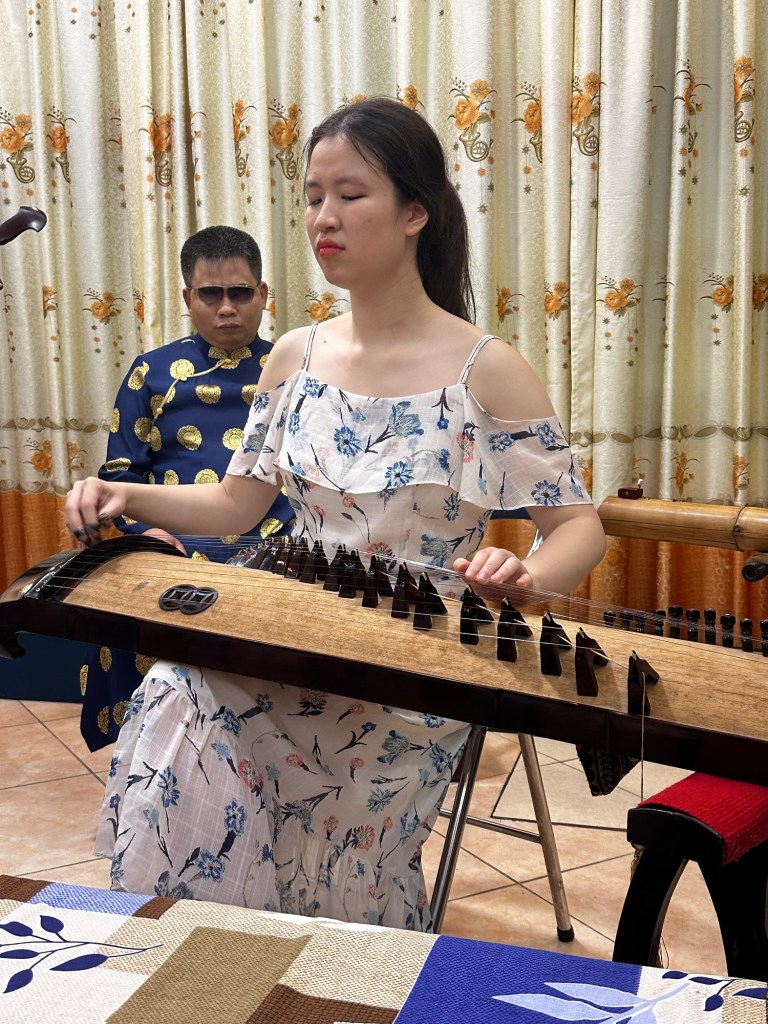
Then she sat before her instrument: the Đàn Tranh, one of Vietnam’s most beautiful traditional instruments.
Until then, it had been an object.
Once she touched it, it became alive.
Her fingers moved across the strings with the certainty of someone greeting an old friend. The first notes rose into the room like light finding a window. There was nothing forced in her playing. No strain, no vanity, no need to show me how difficult it was. She did not attack the instrument; she conversed with it.
I have heard many skilled people in my life. Skill can dazzle. It can command applause. It can even create envy. But there is something greater than skill, and that is sincerity. Her music possessed it.
She played Sakura at one point, and I remember feeling unexpectedly overwhelmed. Not because the melody was unfamiliar, nor because the room was especially dramatic, but because something true had entered the space. I found myself emotional in a way I had not anticipated. I needed a moment alone.
How strange and wonderful that a few strings, touched by the right hands, can disturb the heart more deeply than speeches, arguments, or logic ever could.
As we spoke, I learned that she had begun music young, encouraged by a mother who loved it herself. She first learned piano, then found her path through traditional Vietnamese music. At eight years old, she began studying the Đàn Tranh seriously. Later, in 2014, she entered the Vietnam National Academy of Music.
There was another detail—one she carried so naturally that it would have been easy to overlook. She was visually impaired.
Yet she never presented this as tragedy, and I refuse to present it so now. It was simply one fact among many, and not the most interesting one. The interesting fact was what she had built: mastery through touch, memory through repetition, confidence through discipline, artistry through love.
While others might rely first on sight, she had cultivated listening as an art form. While others watched their hands, she trusted them. While others read notes from a page, she carried music within her.
This, I have come to believe, is how extraordinary people often appear: not as miracles, but as workers.
We imagine greatness as lightning—sudden, dramatic, visible from afar. More often it is candlelight: patient, quiet, maintained daily.
What impressed me nearly as much as her musicianship was her lack of bitterness. There was no complaint in her, no sense that life owed her compensation, no hunger for praise. She spoke of effort as though effort were normal. She spoke of practice as though practice were privilege. She spoke of opportunity with gratitude.
When I told her I believed she might one day become one of Vietnam’s leading musicians, she answered simply:
“I hope so.”
Three words.
No performance of modesty. No false grandness. Just hope, clean and unadorned.
That answer told me as much about her as the music had.
The world often mistakes volume for substance. It celebrates those who announce themselves, market themselves, insist upon themselves. Yet some of the finest people I have met move in the opposite direction. They grow quietly. They work steadily. They let excellence speak where ego might otherwise shout.
She was one of them.
My book is about ordinary extraordinary people, and she belongs here because she embodies the phrase. Outwardly, she seemed ordinary: a young woman speaking politely, smiling shyly, answering questions without fuss.
But ordinary is often only the surface.
Beneath it may live discipline most of us never sustain. Courage most of us never test. Grace most of us never learn. Talent most of us never cultivate. Depth most of us never suspect.
We pass such people every day and do not know it.
That is why I write these chapters.
To remember that greatness does not always arrive in crowns or titles. Sometimes it arrives carrying an instrument. Sometimes it speaks softly. Sometimes it laughs easily. Sometimes it says only, “I hope so.”
And sometimes, if you are fortunate, it sits before you and makes strings speak.


Leave a comment